
What is the Difference Between Rene 41 and Inconel 718?
The question "Rene 41 or Inconel 718?" is a common query in our conversations with aerospace and turbine engineers
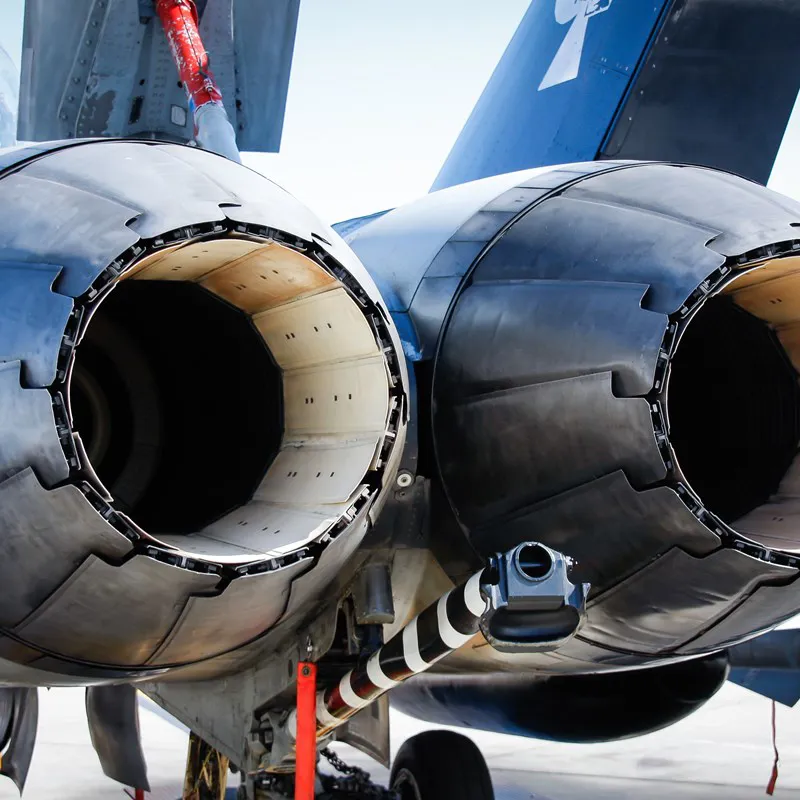
The question "Rene 41 or Inconel 718?" is a common query in our conversations with aerospace and turbine engineers. Both materials are nickel-chromium superalloys, and both have good strength retention properties over 650°C. Both materials can be found in critical components of gas turbines around the world. Despite these similarities, they are fundamentally different materials, each excelling in different applications.
The short answer is that Rene 41 provides better high-temperature strength and creep resistance up to 980°C, making it the choice for the hottest components of gas turbines. Inconel 718 provides good strength up to 700°C, along with better machinability and cost.
The long answer involves understanding the approach each material uses to attain these properties, where each material excels, and why the better material is dependent upon the specific operating environment.
The Chemistry Behind the Performance
Both materials fall into the nickel-chromium superalloy family. A comparison of the chemical compositions reveals the different philosophies each alloy uses to attain its properties.
Inconel 718 contains 50-55% nickel, 17-21% chromium, along with significant amounts of iron (balance), niobium (4.75-5.5%), molybdenum (2.8-3.3%), and titanium and aluminium in smaller amounts. The niobium plays an important role in Inconel 718. In the aging process, niobium precipitates as Ni3Nb and provides good strengthening up to about 650-700°C.
Rene 41 contains a minimum of 55% nickel, 19% chromium, 10% cobalt, and 10% molybdenum, along with titanium (3.1%), aluminium (1.5%), and other elements in smaller amounts. A comparison of the two materials indicates that Rene 41 contains more refractory metal constituents like molybdenum and cobalt, along with aluminium and titanium.
These composition differences are the basis for all other factors, including temperature capability, strength characteristics, processing needs, and ultimately, cost.
Temperature Capability: Where Each Alloy Excels
Temperature capability is often the determining factor between these alloys.
Inconel 718 has excellent strength up to 650-700°C. However, above that, the strengthening precipitates dissolve, and it’s strength drops off sharply. For continuous service, Inconel 718 has a maximum continuous service temperature of 650°C. For short-time or intermittent exposure, Inconel 718 can withstand up to 700°C, although its properties will deteriorate.
This temperature limitation is not a deficiency; it is a design choice. By optimising Inconel 718 for these temperatures, it has excellent fabricability and can be used in thicker sections than many other alloys.
Rene 41, on the other hand, is optimised for much higher temperatures. Rene 41 has excellent mechanical properties up to 980°C and excellent oxidation resistance up to 1090°C. In fact, in gas turbines, Rene 41 components are often exposed to temperatures ranging from 870 to 980°C, where they are subjected to high stress and severe oxidation conditions.
The difference in these temperatures is stark. A component exposed to these conditions, those of 850°C and stress, simply cannot be Inconel 718, as it would creep severely and fail early. Rene 41, on the other hand, can handle these conditions without issue.
Strength and Creep Resistance
Both alloys have similar tensile strengths at room temperature, at approximately 1,240 to 1,380 MPa, or 180 to 200 ksi, depending on heat treatment conditions.
The strength of Inconel 718 is around 70-75% of its room temperature strength at 540°C. It retains tensile strength of 1,000 MPa even at 650°C. This makes it suitable for compressor disc, casing, and fasteners used in the range of 400-650°C.
The alloy’s creep rupture strength is good within the range of temperature. A typical requirement for 718 might be 1000-hour rupture at 650°C at 690 MPa. This is more than sufficient for most aerospace applications with designed lifetimes and inspection intervals.
However, Rene 41 is stronger at high temperatures than 718. Rene 41 can offer 965 MPa tensile strength at 760°C, while 718 is seriously weakened at these temperatures. At 870°C, Rene 41 can offer 690 MPa tensile strength.
However, more importantly, Rene 41 is stronger at high temperatures when it comes to creep. The alloy can withstand high stresses at high temperatures without excessive deformation. This is important for turbine blades, vanes, and combustor components, which need to maintain dimensions at temperatures approaching 1000°C.
Fabrication and Machinability
Here, Inconel 718 is clearly at a disadvantage to Rene 41.
Inconel 718 can be machined in the solution-treated (soft) state and then precipitation-hardened using a relatively simple aging treatment (720°C for 8 hours, furnace cool to 620°C and hold for 8 hours, then air cool). This allows complex geometries to be machined before the aging treatment.
The alloy can be welded using conventional techniques such as TIG, MIG, electron beam, and laser. Welding is a relatively simple process and can be done using standard techniques.
Forging 718 is relatively simple compared to other superalloys. The alloy can be hot worked at 980 to 1120°C using conventional equipment. The simplicity of forging 718 is a reflection of the relatively high availability and cost-effectiveness of 718 forgings.
However, Rene 41 is more difficult to machine. It is important to machine this alloy with appropriate cutting tools since it readily work-hardens and produces a lot of heat during cutting. Even machinists who have experience with other nickel-base alloys may have difficulty machining Rene 41 initially.
Welding Rene 41 is possible, but it is important to properly develop a welding procedure for this alloy. Rene 41 is prone to strain-age cracking if welded in the aged condition. It is usually welded in the solution-treated condition, and then it is treated by solution treating and aging after welding.
Forging Rene 41 is more difficult since it demands precise temperature control, and higher pressures than Inconel 718 are required. It has a narrower hot working temperature range, making it more prone to cracking if the temperature is not within the appropriate range.
The above-mentioned difficulties in processing Rene 41 have a direct impact on its cost. Rene 41 is 40-60% more expensive than Inconel 718, assuming both alloys have the required properties for the specific part.
Heat Treatment Requirements
The heat treatment requirements for Inconel 718 are straightforward:
• Solution treated at 955-980°C
• Age at 720°C for 8 hours
• Furnace cool to 620°C
• Hold for 8 hours at 620°C
• Air cool
This process can be done using conventional air furnaces. This heat treatment is forgiving since minor changes in time or temperature will not have a significant impact on the final properties. This is important since this alloy is appropriate for use when property control is not critical.
Rene 41, on the other hand, is more difficult to heat treat:
• Solution treated at 1080°C (critical temperature control)
• Rapid cool (e.g., air blast)
• Age at 760°C for 16 hours
The temperature of the solution treatment is also important, as if it is too low, the precipitates do not fully dissolve, and if it is too high, there is excessive grain growth. The aging cycle is longer, with a higher temperature than 718, which requires more robust equipment.
The cost of the heat treatment of Rene 41 is 30-40% higher than 718.
Real-World Applications
Inconel 718 leads the way for applications up to 650°C:
Aerospace:
• Compressor discs, blades, fasteners, fastening systems, etc., for moderate temperature applications
• Turbine engine casings, frames, fasteners, fastening systems, etc.
• Rocket motor cases, thrust chambers, fasteners, fastening systems, etc., for cryogenic to 650°C
Power Generation:
• Steam turbine components
• Lower temperature gas turbine components
• Fasteners, fastening systems, etc.
Oil & Gas:
• Downhole tooling, equipment, etc.
• Subsea equipment requiring corrosion resistance, strength, etc.
Industrial:
• Heat treatment fixtures, furnace components, fasteners, fastening systems, etc.
• Chemical processing equipment requiring corrosion, heat resistance, etc.
Rene 41 is used for the most severe applications, i.e., for the highest temperature:
Aerospace:
• High-pressure turbine blades, vanes, fasteners, fastening systems, etc., for military and commercial jet engines
• Combustor components exposed to flame temperatures
• Afterburner components for military jet engines
• First-stage turbine components where metal temperatures exceed 850°C
Power Generation:
• First-stage gas turbine blades, vanes, transition pieces, combustor hardware, etc.
• Transition pieces, combustor hardware, components, etc., in the hot gas path requiring long creep life
Racing (High-End Motorsport):
• Turbocharger turbine wheels above 950°C
• Exhaust valve seats for top fuel racing engines
• Extreme Temperature Exhaust Components in Prototype Racing
It is clear that if you are running your component above 700°C continuously, and it is subject to stress, you need Rene 41. However, if you are running your component below 650°C, then Inconel 718 is of better value.
Availability and Forms of Inconel 718 and Rene 41
Inconel 718 is available in every product form:
• Bar – round, square, and rectangular sections up to 300mm+
• Plate and Sheet – from 0.5mm to 150mm+
• Tube and Pipe
• Wire
• Forgings – both stock and bespoke
The lead times for Inconel 718 are also shorter, as it is produced on a much larger scale than Rene 41.
Rene 41 is not as readily available:
• Bar – commonly stocked up to 150mm diameter
• Plate – not commonly stocked, special order
• Forgings – special order, long lead times
• Other Forms – wire and tube are available, but a minimum order quantity applies
The Consequences of the Wrong Material Choice
Using Inconel 718 in an application requiring Rene 41 will result in premature component failure, excessive creep deformation, and loss of clearance. We have seen blades made of Inconel 718, which should have been Rene 41, last only a fraction of their expected life.
However, using Rene 41 when 718 would suffice is a waste of money and makes the manufacturing process more complicated without any performance advantages. If you require a temperature of 550°C, then it is pointless to pay the premium for Rene 41.f
Technical Specifications and Standards
Both alloys are covered under a wide range of technical specifications and standards for the aerospace and industrial sectors:
Inconel 718:
• AMS 5662 - Bars, forgings, rings (solution treated and precipitation hardened)
• AMS 5663 - Bars, forgings, rings (solution treated)
• AMS 5596 - Sheet, strip, plate (solution treated and precipitation hardened)
• AMS 5664 - Welding wire
• ASTM B637 - Bar and forgings for general applications
• UNS N07718 - Unified numbering system designation
Rene 41:
• AMS 5712 - Bars, forgings, rings (solution treated and precipitation hardened)
• AMS 5713 - Bars and forgings (solution treated)
• AMS 5545 - Investment castings
• Proprietary specifications from engine manufacturers
When purchasing material from a supplier, you should ensure you get the correct specification material. The best way to do this is to ask for the material against the correct AMS specification.
Our Experience with Both Alloys
Since 1997, Dynamic Metals has supplied both Inconel 718 and Rene 41 to the aerospace industry, turbine overhaul industry, and the world of motorsport. From our experience, we know what questions to ask in order to ensure the correct material is chosen.
A motorsport racing team, developing a new turbocharger, contacts us regarding turbine wheel materials. Their design calculations indicate turbine inlet temperatures of 950°C. They are considering 718 due to cost and availability. We recommend Rene 41. At these temperatures, 718 won't even last. It is worth the extra cost to avoid failures.
An aerospace company is designing components for a new engine. Operating temperature range is 540-580°C. They're considering Rene 41 because it is a "better" material. We suggest using Inconel 718. It provides sufficient strength for these temperature ranges and is less expensive. In addition, it provides better machinability for the complex air-foil sections. Using Rene 41 will cost more without any significant benefit. A power generation company needs replacement turbine blades for an industrial gas turbine. Original parts were Rene 41. They're considering Inconel 718 to save money. We analyse the operating environment. Metal temperature will be about 820°C. Operating stress will be sustained. Rene 41 is non-negotiable. Attempting to substitute Inconel 718 will result in rapid creep failure.
Making Your Material Decision
If you're trying to make a decision between using Rene 41 and Inconel 718, ask yourself these questions:
1. What is the maximum continuous temperature?
· Less than 650°C → Inconel 718 is probably sufficient
· More than 700°C → Rene 41 is probably needed
· Between 650-700°C → Detailed analysis needed
2. What stresses will the parts operate under?
· High stresses and temperature → Rene 41 needed
· Low stresses and temperature → Inconel 718 needed
3. How long will the parts need to last?
· Long life and high temperature → Rene 41 needed
· Moderate life and moderate temperature → Inconel 718 needed
4. What environment will the parts operate in?
· Combustion products and high temperature → Rene 41 oxidation resistance needed
· Clean air or inert atmospheres at moderate temperature → 718 is adequate
5. What are your manufacturing constraints?
· Complex machining or welding required → 718 is easier
· Simple geometries with established processing → Rene 41 is feasible
6. What's your budget and timeline?
· Cost-sensitive applications below 650°C → 718
· Performance-critical applications regardless of cost → Material choice is governed by requirements
In closing...
Rene 41 and Inconel 718 are both high-performing nickel superalloys, but they have different design curves for different operating conditions. Rene 41 is superior when operating conditions require temperatures up to 980°C, where its superior creep properties are required. On the other hand, 718 is superior when operating conditions require temperatures below 650°C, where its favourable balance of properties, fabricability, and cost makes it the best choice.
The choice is not which one is better, but which one is appropriate for your operating conditions. Operating at 718 when Rene 41 is required will cause premature failure, and operating at Rene 41 when 718 will suffice will be a waste of money without any performance advantage.
Need more information? Get in touch