
4130 steel is a low alloyed chrome-moly steel, also known as chromoly steel, belonging to AISI designation category of steels, that has both chromium and molybdenum as its principal hardening agents. The "41" number specifies it as chromium-molybdenum alloy family, while the "30" number refers to about 0.30% carbon content. Its chemical makeup consists of 0.80-1.10% chromium, 0.15-0.25% molybdenum, and 0.28-0.33% carbon content, with the rest being iron. The chromium component provides good hardenability, moderate oxidation, and corrosion resistance, along with carbide stabilisation when subjected to heat treatments. Molybdenum gives increased strength and toughness especially when used at high temperatures, providing enhanced creep resistance and temper brittleness resistance. The precise ratio of its carbon content allows for excellent weldability while maintaining proper strength capabilities. Contrary to other types of steels, which tend to develop cracks when joining, 4130's composition makes it excellently weldable even using conventional fusion techniques without preheat, unless dealing with thick sections. 4130 steel belongs to through-hardening alloy category because it can be subject to heat treatments to obtain uniform hardness throughout cross-section, not only surface-hardening. The variety of properties allows for its use in aircraft, motor racing industry for more than a century.
4130 Alloy Steel
Typical Applications
Aircraft engine mounts
Aircraft seating
Roll Cages
Bicycle frames
Well head components
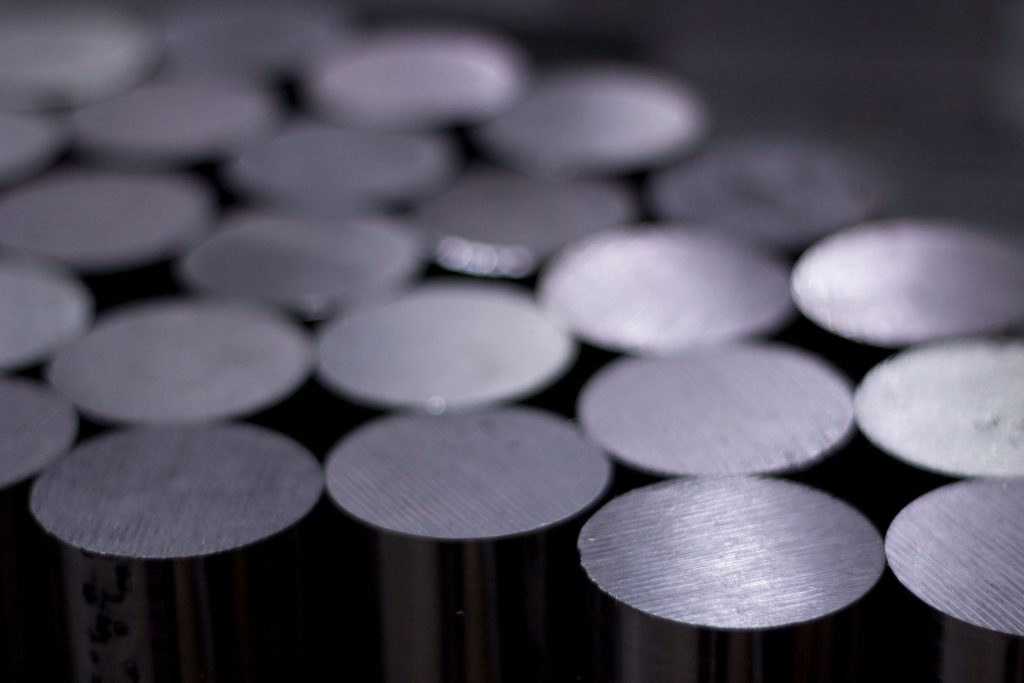
4130 (AMS 6360, AMS 6370, AMS 6371, AMS 6348) is a through hardening low alloy steel containing molybdenum and chromium as strengthening agents. 4130 responds well to nitriding for very good wear and abrasion resistance.
4130 steel can be purchased in various forms including bar, tube, sheet, and plate. Bars and flats are used as base material for machined parts such as aircraft engine mountings and hydraulic shafts. Seamless tubes are widely used in the welding of such items as aircraft fuselage frame, motorsport roll cage, bicycle frame, and pressurised containers for the oil and gas industry. Sheets and plates allow to create parts such as structural panels, gusset, bracket, and many others in the applications that require strength-to-weight optimisation.
Strength-to-weight ratio, coupled with exceptional weldability compared to other alloys with higher carbon content, is the key feature of 4130 alloy. The carbon amount of 0.30% falls within the perfect range providing sufficient strength via heat treatment while not compromising the fusion weldability without cold cracking, unlike 4140 or 4340 steels with higher carbon content. Chromium, present in amounts of 0.80-1.10%, improves hardenability and provides moderate resistance to corrosion, whereas molybdenum, amounting to 0.15-0.25%, increases the alloy strength, toughness, and high temperature creep resistance.
Normalised 4130 grade (AMS 6345 for sheets and plates, AMS 6360/6370/6371 for rods and tubes) has tensile strength of minimum 655 MPa along with good ductility allowing the bending of radii of 1t (one times thickness) for annealed sheet steel. Therefore, the normalised condition can be considered ideal for parts requiring structural strength and no further forming. The annealed condition of 4130 steel (AMS 6350 for sheets and plates, AMS 6348 for rods and tubes) ensures improved machinability and formability for the parts that should be formed, bent or machined prior to heat treatment.
Weldability is a huge advantage of 4130 over other alloys due to their higher strength. Indeed, 4130 can be welded successfully with all types of commercially available techniques, including GTAW/TIG, GMAW/MIG, SMAW/stick, resistance, brazing and soldering processes. In case of thinner pieces, the welding operation may be accomplished without preheat. However, preheating of 150-200°C is recommended for thicker pieces, especially those requiring complex welding. Stress relief at temperatures of 650-700°C is required for highly restrained joints and structural applications to eliminate residual stresses and improve ductility.
The machinability of 4130 grade is better than one of other harder alloys when in normalised and tempered condition, while conventional high-speed steel and carbide tooling can produce good surfaces with appropriate tool life during machining. The normalised condition ensures the hardness level of 92 HRB (22 HRC), which facilitates efficient economical machining yet ensuring adequate wear-resistance for many applications. However, machinability of fully hardened parts becomes increasingly complicated with increasing hardness of the parts, and hard turning or grinding procedures with ceramic or CBN tools may be used for machining.
Formability of annealed 4130 steel is excellent since it permits cold working processes such as bending, stretching, deep drawing and stamping. Furthermore, the hot working, that is forging at temperatures between 1000-1200°C, provides even better formability; however, it is not needed due to very good cold formability. Forging process of this alloy takes place at temperatures between maximum 1200°C and 950°C with satisfactory forgeability during all range of mentioned temperatures.
Related Products
Technical specification
Related Specifications - Bar & Tube
Related Specifications - Sheet & Plate
Specific Gravity
Chemical Composition (WT %)
Typical Mechanical Properties - Bar & Tube
Typical Mechanical Properties - Sheet & Plate
How does 4130 compare to 4140 steel?
Both 4130 and 4140 belong to AISI chromium-molybdenum alloy steel with 41xx family. However, there is about 0.10% carbon difference in these types of steels (4130 has 0.28-0.33% carbon content compared to 4140's 0.38-0.43%), making considerable changes to their characteristics. While 4140 has improved hardenability and provides for a much higher level of ultimate strength (its strength is about 850-1000 MPa compared to 655-850 MPa for 4130), achieving higher maximum hardness as well (about 28-32 HRC compared to 22-28 HRC for 4130). The price paid for these properties is less weldability and formability in comparison with 4130. Weldability of 4130 allows for minimal weld zone hardening and cracking susceptibility. This type of steel is easily weldable without preheat and can have preheat requirement of about 150-200 degrees Celsius when working with thick sections. On the contrary, welding of 4140 requires mandatory preheat (usually 200-300 degrees Celsius) together with strict procedure for heat input and post weld heat treatments. In addition, 4130 can be cold-worked more effectively in annealed state. Applications requiring welding are better served by 4130 because of the weldability property (for example aircraft structures, roll cages, and pressure vessels). For solid machined parts when maximum hardness of steel is necessary (such as gears, axles, and shafts) 4140 proves to be a better choice since no welding is involved.
Can 4130 steel be nitrided for wear resistance?
Indeed, 4130 steel is one of the materials best suited for nitride surface hardening process due to its good nitriding ability. The process of nitriding is thermo-chemical diffusion at relative low temperatures (500-525 degrees Celsius) when new phase consisting of iron and chromium nitrides appears. These compounds have much higher hardness than original steel and create a hard surface layer of about 0.15-0.65 millimeters depending on treatment time period, while still possessing the toughness of the original material. It allows obtaining 700-900 Vickers hardness or about 60-65 HRC of surface layer. The main advantage of nitriding of 4130 steels is high surface hardness, which results in excellent wear resistance to abrasion, fretting, galling and adhesive wear in combination with high resistance to impact loads and shock due to the remaining tough core. Other important nitriding properties are lack of distortions due to treatment temperature (which is lower than tempering temperature), no cracking because of quenching, increased fatigue resistance due to compressive residual stresses of surface layer and possibility to treat already completed products, avoiding further processing such as grinding. The examples of such applications are various aircraft landing gear, hydraulic piston rods, valve stems, gears, cam followers.
What heat treatment and welding considerations apply to 4130?
4130 steel allows for a number of heat treatments to meet certain demands of particular applications, including normalising, annealing and quenching-tempering processes. Normalising at 900-925 degrees Celsius, followed by air cooling is used to refine the grain structure and to relieve internal stresses in order to provide homogeneous mechanical properties and good machinability. It is usually performed after hot-working, welding or forging and is standard condition of 4130 steel for structural applications where strength is not important. Annealing at 840-880 degrees Celsius followed by slow furnace cooling provides the softest, easiest-to-form condition for extensive cold working or machining purposes. When maximum strength is needed, quenching with oil from 870 degrees Celsius temperature followed by tempering at 400-700 degrees Celsius is used for obtaining martensitic structure with tensile strength exceeding 1000 MPa, with tempering temperature chosen according to specific service needs. Low tempering temperature (up to 500 degrees Celsius) provides high hardness and wear resistance while high tempering temperatures (up to 700 degrees Celsius) result in maximum impact resistance and ductility. Welding considerations for this steel are the following – due to excellent weldability, all types of fusion welding (MIG, TIG, stick welding) can be used successfully. Without preheating, welding of sheet material with thickness less than 3mm is possible, while it is recommended for thicker pieces (over 6mm) to preheat to 150-200 degrees Celsius. Choice of filler metals depends on composition of base material (usually, ER80S-D2 and ER90S-D2).

Need more information? Get in touch