
- Aircraft landing gear — the dominant material for decades due to unmatched combination of ultra-high strength, fracture toughness and fatigue resistance through large section sizes
- Rocket motor casings requiring maximum strength-to-weight ratio
- Driveshafts and high-strength fasteners in aircraft structural assemblies
- Gears and drivetrain components under high cyclic loading
- Structural airframe parts where both strength and crack tolerance are required
- Every application driven by the same requirement: maximum strength without sacrificing the toughness needed to survive in service
300m Alloy Steel
Typical Applications
Aircraft Landing Gear
Driveshafts
High Strength bolts
Gears
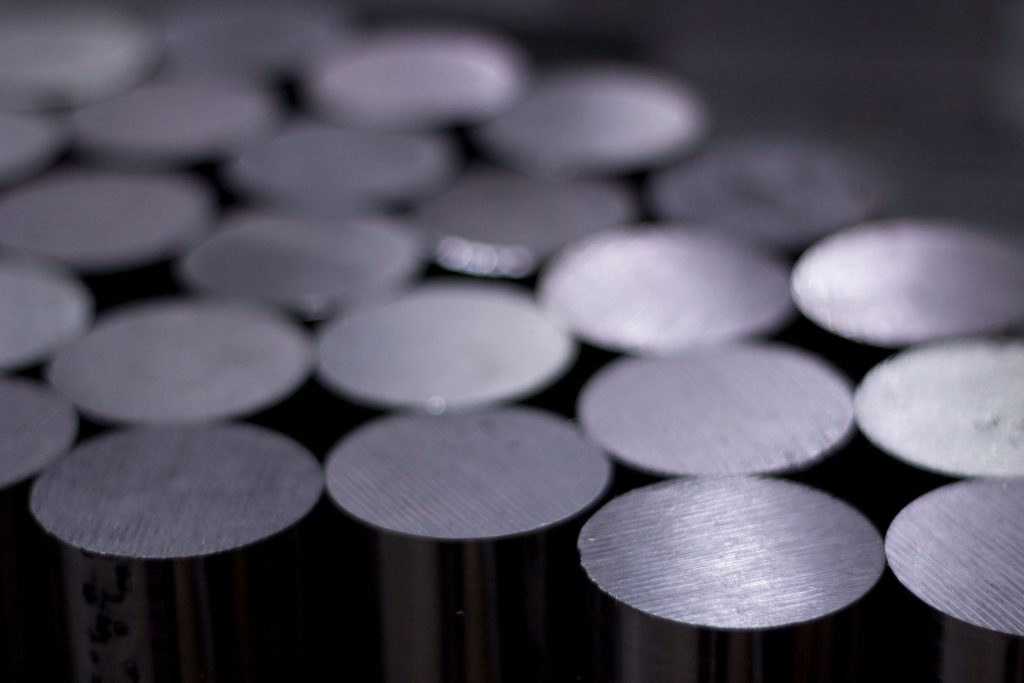
AMS 6257, AMS 6417, AMS 6419 Suppliers & Stockholders
Dynamic Metals is a specialist supplier and stockholder of 300M alloy steel, supplying aerospace and defence industries with certified material to AMS 6257, AMS 6417, AMS 6419 and BS S155. No minimum order quantities.
300M is a low alloy, vacuum melted steel developed as a direct advancement of 4340, with deliberate increases in silicon, vanadium, carbon and molybdenum content. Each addition serves a specific purpose: silicon raises strength and suppresses softening during tempering; vanadium refines grain structure and resists grain growth during heat treatment; the elevated carbon content pushes achievable hardness to a minimum of 52–53 HRC through the full section. The result is a material that delivers tensile strength in the range of 1900–2100 MPa after final heat treatment — the highest through-hardening capability available in any conventional low-alloy steel.
What separates 300M from other ultra-high strength steels is the combination of that extreme strength with genuinely useful fracture toughness and fatigue resistance. The silicon and vanadium additions work together to produce a finer, cleaner microstructure than 4340 at equivalent strength, which translates directly into better performance under cyclic loading — the condition that defines most of 300M's critical applications.
All three governing specifications — AMS 6257, AMS 6417 and AMS 6419 — require production by consumable electrode vacuum remelting. This is not an option but a mandatory process requirement, eliminating the non-metallic inclusions that would otherwise compromise fatigue life and fracture toughness in safety-critical structural applications. Material is supplied in the normalised and tempered condition, ready for the customer to austenitise, oil quench and double temper to final properties.
Full material certification and traceability to the original melt heat is provided with every shipment.
Related Products

Key Features and Benefits
• Tensile strength 1900–2100 MPa after final heat treatment — the highest through-section strength achievable in any conventional low alloy steel
• Minimum hardness 52–53 HRC through sections up to 3.5 inches (89 mm) — verified by rigid magnetic particle inspection standards under AMS 6257, AMS 6417 and AMS 6419
• Silicon addition (1.45–1.80%) prevents softening during tempering, preserving strength at the double-temper temperature of 302°C (575°F)
• Vanadium addition (0.05–0.10%) refines grain structure and resists grain growth during heat treatment — directly improving fracture toughness relative to 4340 at equivalent strength
• Mandatory consumable electrode vacuum remelting across all three specifications — eliminates inclusions critical to fatigue and fracture performance in landing gear and structural applications. Supplied normalised and tempered, ready for customer heat treatment to final properties
Technical specification
Related Specifications
AMS 6257
AMS 6417
AMS 6419
BS S155
BMS 7-26
MTL 1201
MIL S 8844
Specific Gravity
7.83 g/cm3
Chemical Composition (WT %)
Min
Max
C
0.39
0.44
Si
1.5
1.8
Mn
0.6
0.9
P
-
0.015
S
-
0.015
S+P
-
0.025
Cr
0.7
0.95
Mo
0.3
0.45
Ni
1.65
2
V
0.05
0.10
Typical Mechanical Properties
Longitudinal
Transverse
0.2% Proof Stress
MPA
Min
1550
1550
Tensile Strength
MPA
Min
1900
1900
Tensile Strength
MPA
Max
2100
2100
Elongation
%
Min
8
5
Reduction of area
%
Min
30
20
- Heat treatment route: normalise, austenitise at 871°C, oil quench, double temper at 302°C (two cycles of two hours each)
- Tensile strength 1900–2100 MPa with 0.2% proof stress minimum 1586 MPa under AMS 6257 and AMS 6419
- Longitudinal elongation minimum 8% (7% under AMS 6417) — confirms meaningful ductility at extreme strength levels
- Reduction of area minimum 30% longitudinal — confirms energy absorption capability at maximum strength
- Transverse properties specified and tested, with reduction of area requirements stepping down by section size
- Minimum hardness 52 HRC (AMS 6417) and 53 HRC (AMS 6419 and AMS 6257) — verified through magnetic particle inspection
- Rated for parts up to 3.5 inches (89mm) cross-sectional thickness — through-hardening fully achievable within this range
- Low-alloy structural steel — not a corrosion-resistant grade; surface protection required for most service environments
- Aerospace structural components are typically coated or plated after final machining and heat treatment
- Susceptible to stress corrosion cracking under certain design and processing conditions after heat treatment
- ARP1110 defines recommended practices to minimise stress corrosion cracking risk
- Design and processing practices should be reviewed against ARP1110 guidance before specifying 300M in aggressive or sustained-load environments
- All three specifications — AMS 6257, AMS 6417 and AMS 6419 — require production by consumable electrode vacuum remelting
- AMS 6257 mandates premium aircraft-quality cleanliness to AMS 2300, with specific limits on average frequency (F) and severity (S) ratings of non-metallic inclusions
- Macrostructure examination of transverse cross-sections is an acceptance test on every heat — no pipe, cracks or inclusions beyond ASTM A604 macrograph limits permitted
- Average grain size certified to ASTM No. 5 or finer (AMS 6417, AMS 6419) or ASTM No. 6 or finer (AMS 6257)
- Decarburisation limits specified and tested by section size across bar and tubing product forms
- Every heat certified with full traceability to the original vacuum remelt
- Supplied in normalised and tempered condition — hardness not exceeding 341 HBW — machinable using appropriate tooling and cutting parameters
- Final heat treatment follows machining: normalise at 927°C, austenitise at 871°C, oil quench, then double temper at 302°C with two cycles of two hours each
- Double tempering is essential — single tempering is not sufficient to develop the toughness required for aerospace structural applications
- Decarburisation depth controlled and tested across all supply forms
- Bars ordered ground, turned or polished must be free from decarburisation on finished surfaces
- Bar shall not be cut from plate under any of the three specifications — this is an acceptance test requirement, not a guideline
- Dimensional stability through heat treatment should be accounted for in machining allowances
- Bar, forgings and mechanical tubing — AMS 6257, AMS 6417 and AMS 6419
- Supplied in normalised and tempered condition
- No minimum order quantities on stock items
- Suitable for both prototype development and full production requirements
- Specific specification revision and certification confirmed against customer engineering organisation requirements on request
- Delivers the highest through-section strength of any conventional low-alloy steel while retaining fracture toughness and fatigue resistance demanded by safety-critical structural applications
- Decades-long dominance in aircraft landing gear reflects genuine engineering advantage — not legacy habit — that newer materials have not displaced in the majority of applications
- Silicon and vanadium additions produce a measurably different microstructure from 4340 — performing better under the cyclic and impact loading conditions that define aerospace structural service
- Mandatory vacuum remelting across all three governing specifications ensures cleanliness required for fatigue-critical applications is built into the procurement document — not left to discretion
- Specialist supplier of 300M to aerospace and defence customers since 1997
- Certified stock held to AMS 6257, AMS 6417 and AMS 6419 with full material certification and traceability to original vacuum remelt heat
- Team available to advise on specification selection, heat treatment routes and machining considerations
- No minimum order quantities — supports both development programmes and production contracts
- AS9100 certified
- Fast UK delivery on standard stock sizes

Need more information? Get in touch